 Villages Mobility Scooter Repair
Battery Replacement for Scooters and Power Chairs
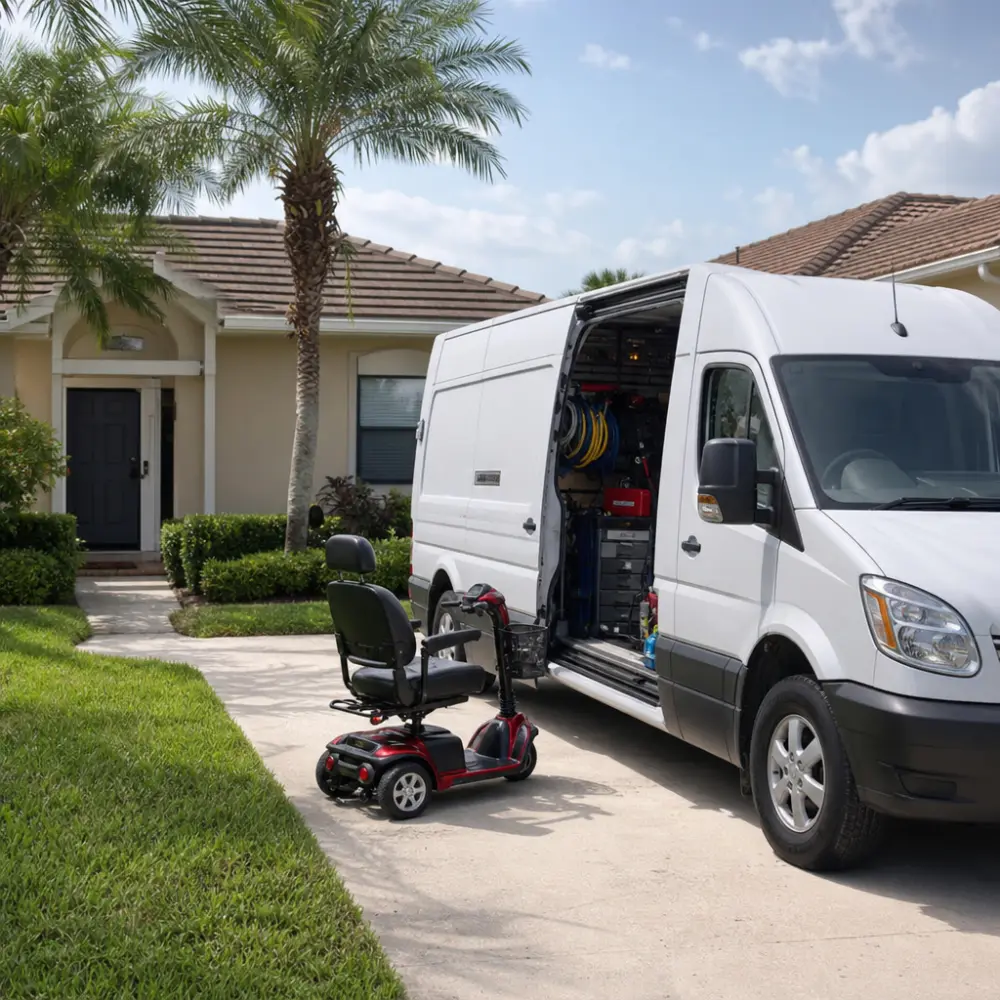
A battery pack that will not hold a charge, or a scooter that suddenly has a fraction of the range it used to, is the single most common reason for a service call. Sealed lead-acid batteries have a real service life, and Florida heat shortens it. A load test should come before any recommendation, and the correct replacement can usually be installed on-site in the same visit.
How to tell a battery is actually the problem
A resting voltage reading only tells you so much. A battery can sit at what looks like a healthy voltage and still collapse the instant the motor draws real current, which is why the test has to be under load:
- Resting voltage on each battery individually, not just the pack as a whole.
- Load test, applying a real draw and watching how far the voltage sags and how fast it recovers.
- Charger output test, since a charger that has failed produces the exact same symptom as a dead battery: nothing charges.
- Terminal and connection check, since corrosion at a terminal can mimic a battery failure while the battery itself is fine.
If the batteries fail the load test, replacement is the honest recommendation. If they pass, the charger and connections are the next suspects, covered in more depth on the charger and electrical repair page.
Power chair batteries are a different job
A power wheelchair is not a big scooter as far as the battery goes. Almost every chair we see runs two 12-volt deep-cycle batteries wired in series for 24 volts, and they are bigger and heavier than a typical scooter pair. Which size depends on the model, and the owner’s manual lists it in the specifications table. Pride’s own manuals, for example, call for:
| Pride Jazzy model | Batteries specified |
|---|---|
| Jazzy Select, Jazzy Select Elite | Two 12-volt U-1 batteries |
| Jazzy Select 14 series | Two 12-volt deep-cycle NF-22 (22NF) batteries |
Three rules from those same manuals decide how we do a power chair battery job:
- Both batteries, same type, same amp-hour rating. Pride prohibits mixing chemistries or capacities, and its load-test instructions say that if either battery fails, replace both. A new battery paired with a tired one gets dragged down by it.
- A flat chair may refuse to charge at all. The manual notes the charger “will not operate after the batteries have been discharged to nearly zero voltage.” That is the classic story when someone returns to The Villages in the fall to a chair that sat in a hot garage all summer: the charger light does nothing, and the cause is the batteries rather than the charger. We test both before quoting either.
- New batteries need a few cycles. A fresh pair reaches full capacity after four or five complete charges, so range on the first day or two is not the final word.
If the chair will sit for weeks, Pride’s guidance is to charge at least once a week, or charge fully, disconnect the battery harness, and store it somewhere that is neither freezing nor very hot. Owner’s manuals: Jazzy Select Elite, Jazzy Select 14. Other brands follow the same 24-volt pair layout but with their own sizes, so check your chair’s spec table, or have us read it off the batteries at the visit. For motors, joysticks and the rest of the chair, see power wheelchair repair.
Lead-acid vs lithium, the honest version
Most scooters and power chairs on the road here run sealed lead-acid (SLA/AGM) batteries, a pair for most scooters, a larger pack for many power chairs. They are the lower upfront cost option, typically $150 to $450 installed, but they have a finite number of charge cycles and lose capacity faster in sustained heat, which describes most Florida garages for a good part of the year.
Lithium replacements cost significantly more up front, generally $500 to $1,000 or more for the battery itself, but last longer between replacements, weigh less, and need no watering (lead-acid batteries with removable caps require periodic water top-offs; sealed AGM versions do not, but still age on the same clock). Whether the upgrade makes sense depends on how hard the scooter or chair is used and how long you plan to keep it. Ask to see the real math rather than accept the more expensive option by default.
Why batteries fail faster here
Heat is the main mechanism. Sustained high temperatures accelerate the internal chemical processes in a lead-acid battery, both the useful ones and the ones that shorten its life, and a garage or a shed that sits hot for much of the year works on a parked battery even when the scooter is not being used. This is different from a battery just aging on the shelf; heat actively shortens the calendar life, not only the cycle life.
Sitting unused is its own failure mode. A scooter that goes unused for weeks, whether from a trip, a hospital stay, or simply not being needed, discharges slowly on its own and can end up deeply discharged without anyone noticing. A lead-acid battery left in a deeply discharged state for an extended period often sulfates and loses real capacity permanently, which is a different problem than normal wear and is why “it just sat in the garage” is a common story behind a battery that will not take a charge anymore.
Daily errand mileage adds up. A scooter used for a daily trip to the pool, the pharmacy, or a clubhouse puts real cycles on a battery pack the same way a car puts miles on a set of tires, and a pack under that kind of regular use ages out faster than one used occasionally.
What it costs
| Job | Typical range |
|---|---|
| Sealed lead-acid pair or pack, installed | $150 to $450 |
| Lithium upgrade (battery only) | $500 to $1,000+ |
| Load test / diagnostic (part of the home visit) | $75 to $150 |
| Charger repair, if that is the actual fault | $80 to $250 |
Ask whether haul-away and recycling of the old batteries is in the quote; lead batteries should never go in the trash. Full pricing detail is on the pricing page, and the battery cost calculator turns these ranges into an estimate for your scooter or chair specifically.
A note on Medicare and battery replacement
Medicare Part B can cover a repair to durable medical equipment you own, including a battery replacement, when it is necessary to keep the equipment serviceable and the equipment is within its reasonable useful lifetime, but only through a Medicare-enrolled supplier. We are not enrolled with Medicare and cannot bill it; our battery work is private pay. If your scooter or chair is still Medicare-covered, your original DME supplier is the right first call for a Medicare-billed battery replacement. The full, sourced explanation is on the pricing page.
Service area
On-site across The Villages, Leesburg, Lady Lake, Wildwood, Fruitland Park, Summerfield, Oxford, and Tavares. If your scooter is beeping about a battery fault specifically, the Pride Mobility brand page covers Go-Go and Jazzy fault codes in more detail.
Frequently Asked Questions
How do I know if it's the battery or something else?
A load test is the honest answer, not a guess based on age alone. Each battery should be measured under real current draw, not just resting voltage, since a battery can read fine sitting still and collapse the moment the scooter tries to move.
How much does a battery replacement cost?
A sealed lead-acid pair or pack installed typically runs $150 to $450, depending on voltage and battery size. A lithium upgrade runs more up front, roughly $500 to $1,000 or more for the battery alone, but lasts longer and needs no watering.
Do I have to buy the exact same battery brand?
No, but voltage, amp-hour capacity, and physical size (group size) need to match what the scooter or chair was designed for. Insist on batteries sized correctly for your model, not whatever is cheapest.
My power chair sat all summer and now the charger does nothing. Is the charger dead?
Often not. Pride's manuals note the charger will not operate once the batteries are discharged to nearly zero voltage, which is what a long, hot summer in the garage does. Test both batteries first; if either fails a load test, replace the pair, since mixing a new battery with an old one is prohibited.
What happens to my old batteries?
We take them away for recycling. Lead-acid batteries have real core value and should never go in household trash; a licensed recycler is the only correct disposal path.
More mobility services
Areas we serve
- The Villages, FL
- Mobility Scooter & Power Chair Repair in Fruitland Park, Florida
- Mobility Scooter & Power Chair Repair in Lady Lake, Florida
- Mobility Scooter & Power Chair Repair in Leesburg, Florida
- Mobility Scooter & Power Chair Repair in Oxford, Florida
- Mobility Scooter & Power Chair Repair in Summerfield, Florida
- Mobility Scooter & Power Chair Repair in Tavares, Florida
- Mobility Scooter & Power Chair Repair in Wildwood, Florida